




Machined and Injection Molded Plastic Solutions: Choosing the Right Approach for Your Product
In today’s manufacturing landscape, plastic components are indispensable across industries — from medical devices and electronics to automotive and industrial applications. Two of the most widely used production methods for plastic parts are machining and injection molding. While both deliver precise and durable components, they differ significantly in design, process, cost, and suitability depending on the project’s scale and complexity.
What Are Machined and Injection Molded Plastic Solutions?
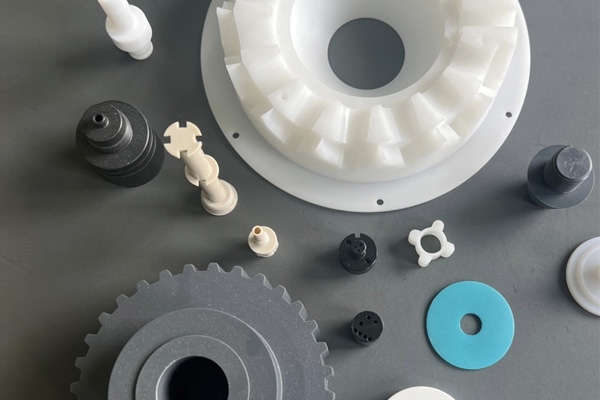
Machined plastic solutions involve cutting, drilling, or milling solid plastic stock into the desired shape using CNC machines. This process is ideal for producing prototypes, smaller batches, no draft angles, no inlet points, no parting lines, for none-thermoplastic materials like PTFE and/or parts requiring tight tolerances. Machining allows for quick adjustments and the use of a wide variety of engineering plastics without the need for costly tooling.
Injection molded plastic solutions, on the other hand, involve melting plastic pellets and injecting them into a custom-designed mold under high pressure. Once cooled, the molded parts are ejected and ready for use. Injection molding is highly efficient for larger-scale production and ensures consistent quality across thousands—or even millions—of units.
When to Choose Each Method
Choosing between machining and injection molding depends on your project’s stage, material selection, quantity requirements, design complexity and investment budget.
• Machined plastic is typically chosen for materials that cannot be injection molded, for lower volume production, and when there is no budget for tooling.
• Injection molding becomes the preferred solution for medium to high-volume production and thermoplastics can be used. Once the design is finalized, the upfront tooling investment is quickly offset by the low per-unit cost and production speed.
Pros and Cons
Let’s have a quick look at some pros and cons
Machined Plastic Pros:
• No need for tooling costs (investment and maintaince)
• Fast turnaround for prototypes and production
• High dimensional accuracy and surface finish
• No inlet, draft nor parting lines
• Flexibility to modify designs quickly
Machined Plastic Cons:
• Higher cost per-part for larger volumes
• Material waste due to subtractive processing
Injection Molded Plastic Pros:
• Cost-effective for large quantities
• Excellent repeatability and surface finish
• Capable of complex shapes and detailed features
• Wide range of materials and colors available
Injection Molded Plastic Cons:
• Initial tooling cost
• Longer lead time before first out of tool (FOT)
• Design changes might require new tooling
Acoplastic and Kirk Plast Complete: Your Full-Service Partner
Acoplastic works closely with our sister company Kirk Plast Complete – a plastic injection molding and rapid tooling manufacturing company. Kirk Plast Complete has a mission to make things easier for the customers. Together with Acoplastic, we are your sparring partner in the entire process from idea to finished product. We have achieved complete satisfaction when, together with you, we have found a better and often more competitive solution than you expected.
Kirk Plast Complete master injection molding from micro parts up to 1.25 kg and has an in-house tool shop specialized in rapid tooling based on inserts for master molds. With one point of contact, our customers benefit from seamless collaboration, shorter lead times, and optimized solutions—whether your project calls for machined prototypes or large-scale injection molded production.
In our selected cases we present a case, where we helped a customer with a challenge regarding machined and injection molded plastic solutions. Read the case here.
Reliability isn’t expensive, it’s priceless.
If you have any questions or inquiries, please feel free to contact us:
Phone: +45 4925 2160
Email: info@acoplastic.dk
https://acoplastic.dk/